Making Conspiratio
Making Conspiratio
By Isabelle Cedotti
The digital version of Conspiratio sprang from the desire to constitute, through texts, a group interested in studying of Illich’s ideas. The printed version of Conspiratio also forms a group: of those who make it and those who will have a physical book in their hands to read.
I will tell you a few stories about the group that makes the printed version of Conspiratio.
In Brazil, my formation was mainly as part of a group of young artists who worked together. We were a group of art students and a teacher, the artist Ernesto Bonato.
Conjointly, we spent hours and days together. We saw the effort of drawing the human figure be transformed into lines, into volume, into the recognition of each other presences, into understanding… We saw the human figure take shape as shoulders, eyes, ears.
It was nothing like the search for hyperrealism shaded by construction tricks, which is quite common in face drawings today. Instead, it was a discovery of ways to be that emerged from being together and sharing the act of drawing and painting.
Our joint learning also took place amid those who came before us through our study of art history. We recognized fragments of what we were looking for in these works from other times, which became clearer through our artistic praxis. Although recurrent in history, it was up to us to rediscover the possibilities of being and being together through the artistic praxis. Such testimony happened through the practices of drawing, painting, and printmaking. And taught us about something that can be shared across time, space and not only among people face to face.
Ten years have passed since those encounters which began when I was 19 years old and in the first year of the Visual Arts program at UNICAMP (State University of Campinas).
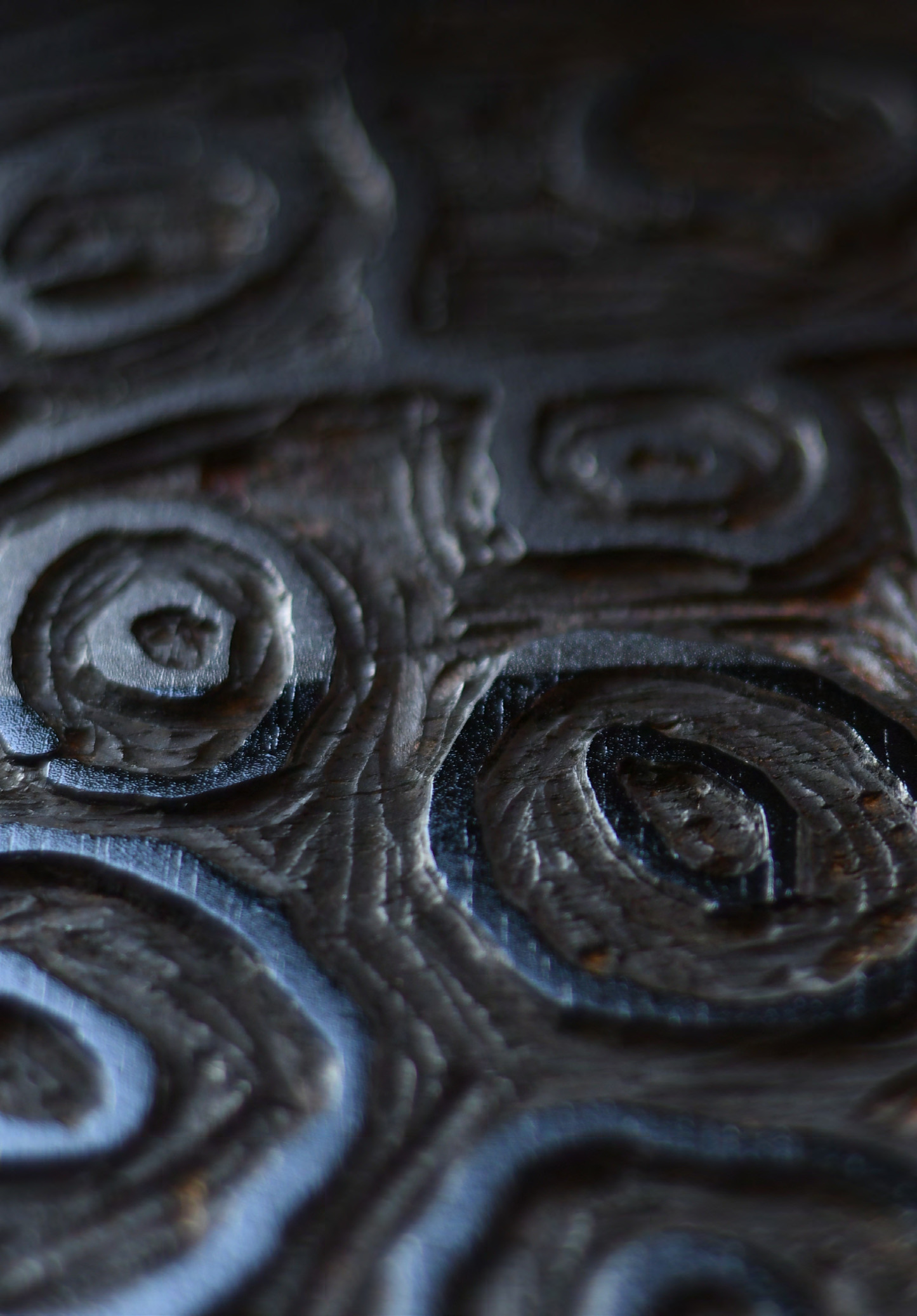
In this year, 2022, that same teacher reintroduced me to the work of a generation of Brazilian artists who collectively carved a 1515 image by the German artist Albert Dürer. In this work of 2003, the original woodcut of the Rhinoceros, which was 24.8 x 31.7 cm, was enlarged to approximate the size of an actual animal of this species – the final image was 2.26 x 3 meters.
Divided into 15 plates, the large image was carved over the course of a year by eight different artists1). Each carved on her or his piece of the wood a segment of the full-sized rhinoceros by enlarging the lines that were carved almost 500 years ago by Dürer. These artists, attentive to the movement of Dürer’s carved lines, shared something with him through their gesture of cutting the wood. It was an intense encounter shared through praxis, even though separated by different moments in time.
After the wood carvings were finished, these plates generated, through printing, a series of reproductions of the large Rhinoceros. The artists spread these large, reproduced images across different cities thereby putting together a scattered art intervention.
Woodcut is a technique of image reproduction that was widely used in images that composed books at the beginning of the printing press. It was a way of reproducing a drawing, just as using wooden movable types was a technique to reproduce the written word. Woodblock prints can be made in a variety of ways. The principle of printing carries the principle of woodcut itself: when the wood is carved, gouges and incisions are created on its surface; later, the surface is inked. However, the incisions do not receive the ink layer, only the surface without gouges receives it. The paper is laid on the woodblock, receiving the ink from the preserved surface, transferring the image from the plate to the paper. There are several ways to apply pressure on the back of the paper so that the ink is transferred from the wood into the paper. In manual printing, wooden spoons and barens are often used to place pressure on the back of the paper so the ink can be transferred from one surface to the other. In large-scale woodcuts, manual printing can be lengthy and requires close attention since the amount of pressure, once defined and consistently applied, determines the aspects of the image.
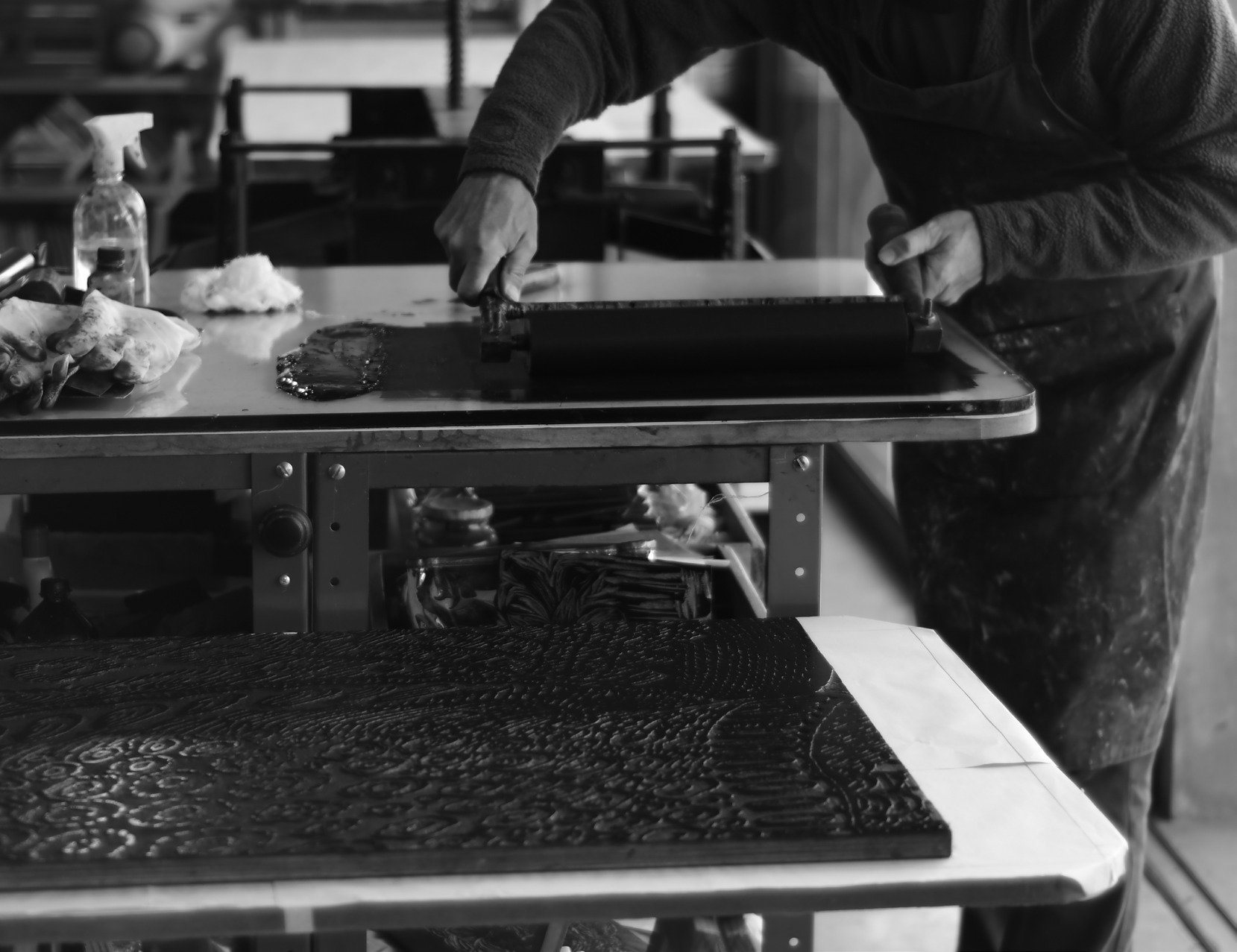
Several types of printing presses are alternatives to manual printing. Yet, it is common to resort to manual printing when artists seek refinement in the amount and variation of applied pressure or when the woodcut plate is too big to fit the most usual printing presses (mostly adapted to serve the printing market of books, posters, and leaflets).
Due to the dimensions of the Rhinoceros, new printings require a kind of mutirão2), a collective effort. As part of a new generation, I participated in the manual printing of the plates which compose the image at two different times. My first mutirão happened in the first years of university. We worked during nights and after class time, when professors and staff had already gone to their homes and the Art Institute was silent and “officially” closed. On such nights, only our small group of printers and a few students from the music course, seen between the rehearsal rooms and the distant corridors, were present. The Institute was transformed on these occasions, it was like the unveiling of a new atmosphere for us. There we felt very close to each other, our laughter echoed throughout the corridors and resonated within the silence of the Institute, forming a rhythm between the moments of relaxation and concentration that the endeavor demanded.
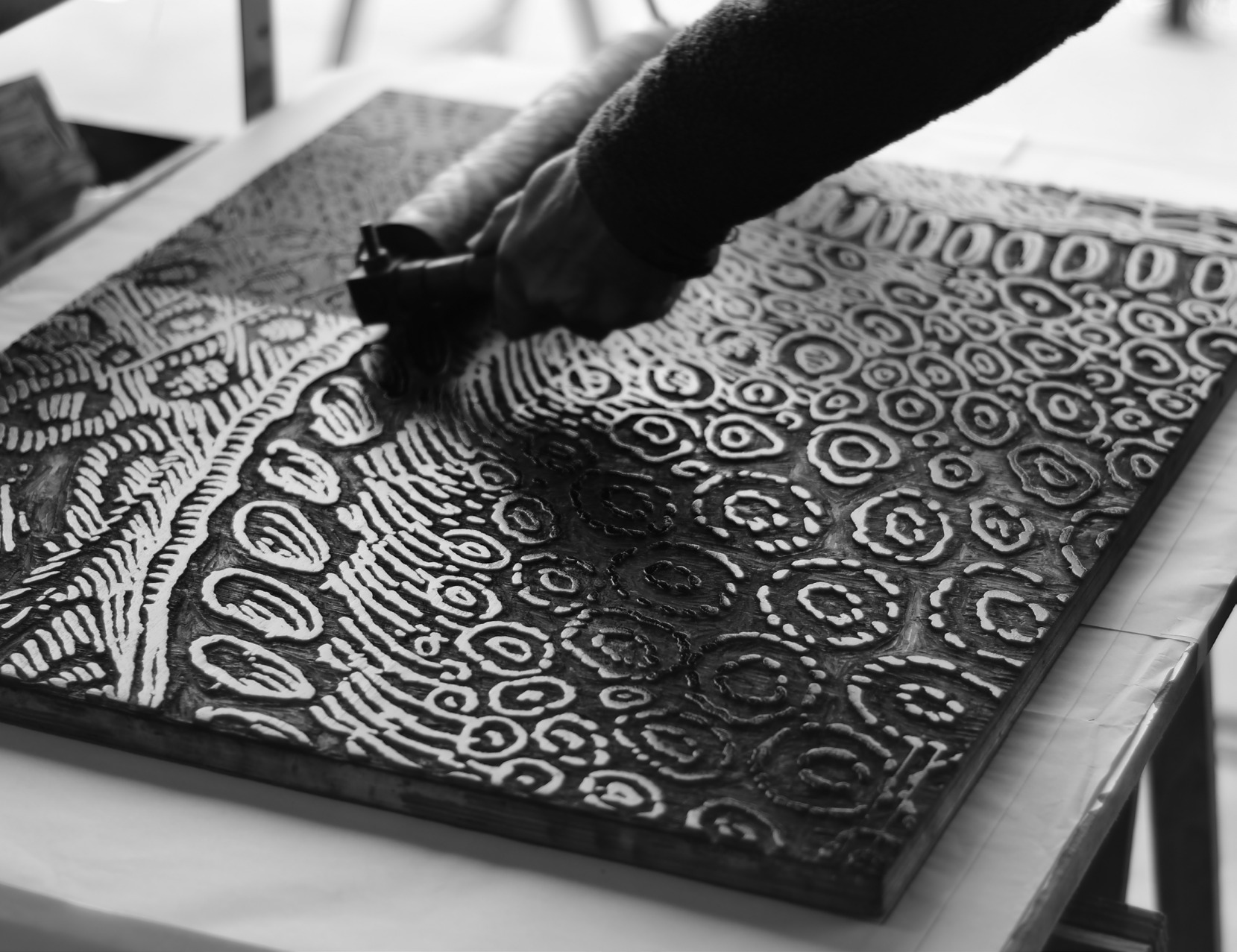
It was in this year of 2022 that I was part of mutirão for a second time, with those wood plates that carry fragments of Dürer’s now great Rhinoceros. This time, I lived in De Etser’s art studio, a collective printmaking art studio in the city of São José dos Campos, Brazil. That feeling of working collectively into the night was very familiar from my university years but amplified at the art studio. The same teacher from 10 years ago invited me to live in a house, an open space in this complex for collective artistic work. Among printers, painters, a ceramist, bookbinders, educators, and people who research and build bamboo houses, we shared spaces and places, travelled the long distances on the little road to the city, lived together with some, and experienced the darkness of nights in those rural areas.
At this collective, Cláudia Gütlich and Carmen Sapede run a bookbinding studio, which is located under the printmaking studio and next to the kitchen. On visits to the small atelier, leafing through and asking about the abundant work done by them, Conspiratio took shape. We jointly investigated different papers, formats, threads, stitching techniques, and researched assembly methods. Conversations about the region and our families interspersed our discussions like salt and spice in a dish. Now, we tested the possibilities of one type of paper compared to another, debated ideas on how to bind, and to put together these texts. Then, we shared recipes to heal colds and discussed the difficulties bringing up children. My companion Neto and I, who were living there for a few weeks, had a reason, due to Conspiratio, to be at the book binding studio almost every day. The personal blended into the professional in this communal setting: questions about whether we were adapting well to the new house and to the cold nights of the region shaded into conversations about previous works. We listened and talked! On these occasions, and largely because of the growing curiosity surrounding Conspiratio, we talked a lot about Ivan Illich. During the soup and wine evenings, organized by the group that lives or frequents this place, we were invited to share our journey with Ivan Illich’s ideas. In this conversation, we agreed to expand the topics started there. By the time we got to the final format of Conspiratio, many afternoons had been spent in the small atelier and in the big kitchen. The design of Conspiratio would have to include two competing demands: to have its stitching exposed and to have a spine with title and date information. The solution was to design a slipcase. The reader holding Conspiratio may feel like the recipient of a letter from afar: removing the periodical from the slipcase is reminiscent of extracting a letter from an envelope.
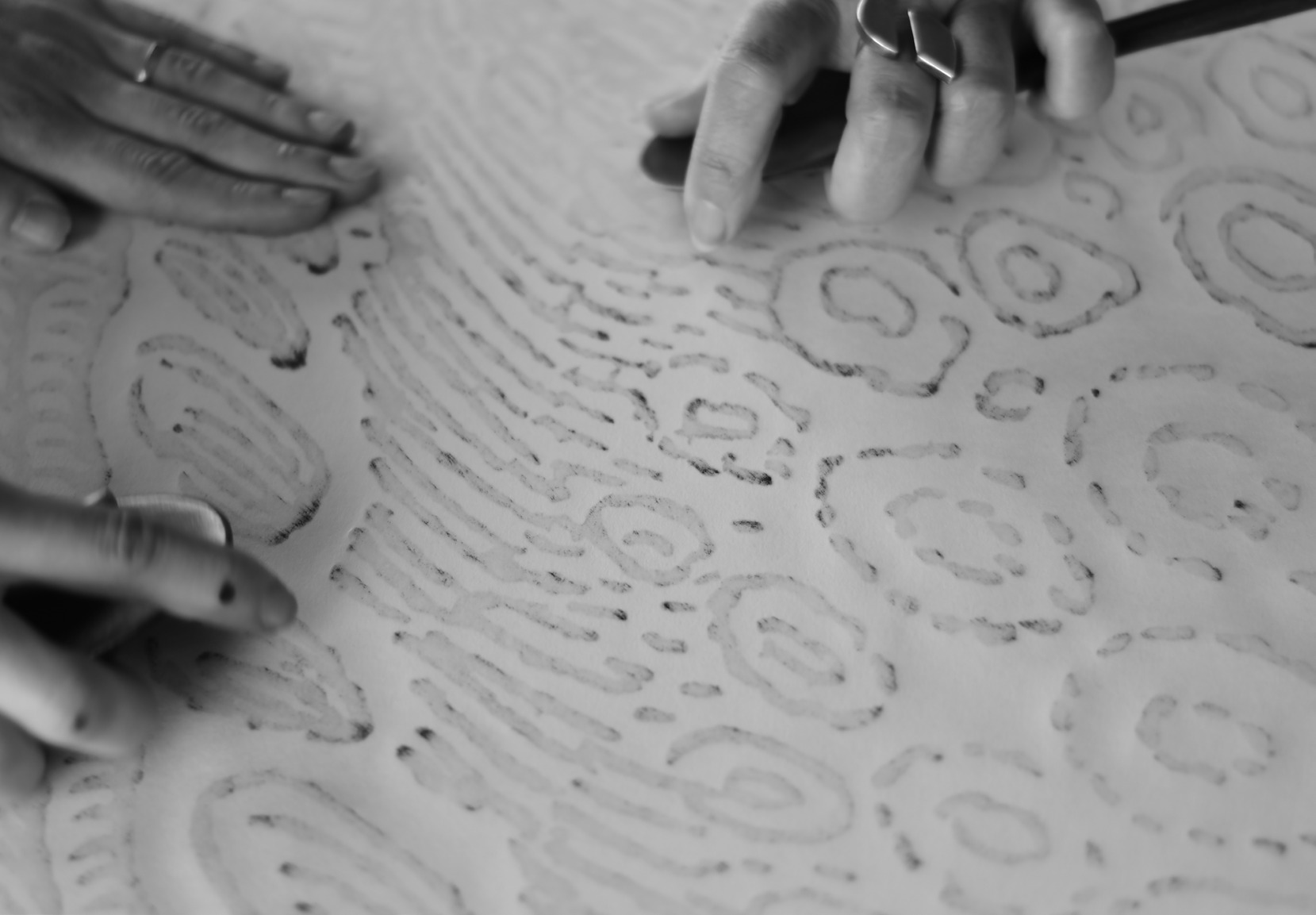
When we started to make volume 1 of Conspiratio, we shared the required tasks, between folds, cuts, creases, gluing, holes, presses, stitching… and many other things that Cláudia and Carmen coordinated. Volume 1 of Conspiratio emerged from a ten-hands effort, and with the contribution of other friends, who were often there cooking, sharing their own work, and inspiring us with ideas.
This issue of Conspiratio carries on the cover of each volume a detail from the great Rhinoceros. Its printed images once united far flung corners of a large Brazilian city. Today, when each reader extracts Conspiratio from its slipcase, she or he will confront a small portion of the rhino. Each volume of this issue as it goes into the world to be held and read is joined to the collective that made it through the fragment on the cover. None can see the whole rhinoceros and yet, each feels part of that invisible whole.
The atmosphere of con-spirare, of breathing together, is given wing when work is born out of a shared place and time. Or, when time is born from shared spaces and work. Or when there is room for shared time and work. Between the time of the text and the stitching of the gathered pages, we hope to find a room open to the encounter.
Gallery of images


mmon areas and to many other endeavors. Mutirão lightens the burden of heavy work through collective effort.